About Me
My primary objective as an academic is to empower students with lifelong learning skills by actively involving them in various processes of knowledge construction. In pursuit of this goal, I am consistently seeking innovative approaches to engage students in knowledge creation, with a specific focus on scientific research. I lead the University’s Genome Engineering Laboratory (www.westmingenlab.uk), providing a sustainable platform for scholarly student innovation and short-term internships and international visiting fellowships for skill development to support their research ambitions.
Education:
BSc Biotechnology;
MSc Microbial Gene technology;
PhD Life Sciences(Molecular Cell Biology),
PGCert Higher Education
Senior Fellow of Higher Education Academy – SFHEA
Fellow of the Royal Society of Biology – FRSB
Member of Academic Council of the University of Westminster
Awards/recognitions: Vice Chancellor’s WestminSTAR award (2019); chosen as 1 million women in STEM role model; Women of Westminster award (2020)-under category innovation; Westminster champion award for student experience (2019); Aurora women Leadership in Higher Education champion and role model (2018); Award of individual teaching excellence from CETI (2019), University of Westminster
My key priorities include:
* Implementing a structured and transparent approach to research and knowledge exchange
* Advocating for the representation of women’s voices in research
* Mentoring colleagues in identifying international research income opportunities
* Creating platforms for sharing research-engaged, research-led and research- informed practices across schools.
About me:
In 1999, I earned my BSc in Biotechnology from Kongunadu Arts and Science College, Bharathiar University, achieving the distinction of a university medal recipient. Following this, I pursued an MSc degree in Microbial Gene Technology, securing my place through a national-level selection process at the Department of Microbial Technology, Madurai Kamaraj University. My academic journey continued with a Council for Scientific and Industrial Research lectureship and research fellowship (CSIR), obtained through a highly competitive national-level selection. This opportunity led me to join the top research institute in the country, the Indian Institute of Science (IISC), Bangalore, India.
During my PhD studies at the Indian Institute of Science (2001-2007), I made a groundbreaking discovery by identifying neutralising antibodies against Abrin, a highly potent RNA-degrading protein. My research findings, including the identification of the antibody D6F10 with clinical application potential, were published in prestigious international journals. Further recognition for my academic contributions includes the Edward Youde grant allowing me to deliver an invited talk at City University of Hong Kong in 2003. Additionally, I initiated an interdisciplinary collaboration with the Physics department of IISc and Brookhaven National Laboratory (USA) aimed at elucidating the structure of Abrus Agglutinin. My doctoral thesis was published as a comprehensive book by Lambert Academic Publishing, Germany, in 2009. Driven by a profound interest in the nuclear events that influence human cell health and disease, I dedicated four years to serving as a European Framework for DNA Repair Postdoctoral Research Fellow in one of the leading labs in DNA mismatch repair research within the Institute of Molecular Cancer Research at the University of Zurich.
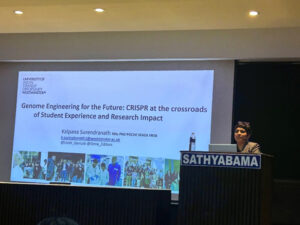
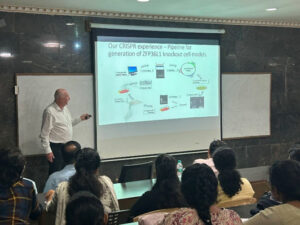
Following a five-year maternity break to raise my only child, I joined the University of Westminster in 2015 as a part-time Lecturer. My role involved substantial contributions to teaching across ten undergraduate and postgraduate modules. A significant milestone during this period was my introduction of CRISPR, marking the first instance of its incorporation into both teaching and research extensively at a post-92 university in the country. In 2017, I transitioned into a full-time role and established the Genome Engineering Laboratory (www.westmingenlab.uk). Here, I recruited and mentored PhD students, with a primary focus on identifying novel targetable vulnerabilities in childhood cancers. To date, I have successfully supervised three PhD students to completion. Currently, I supervise one PhD student and co-supervise three other doctoral researchers